
To get cited by AI in a way that brings you buyers, your brand has to win two contests. AI first picks a handful of sources to read, then builds its answer from the facts those sources agree on.
Win the first contest and lose the second, and AI uses your content while the answer leaves your brand out.
We learned this from our own tests on ChatGPT, Gemini, Google AI Mode and Google AI Overview. We published pieces, asked the same questions over and over, and checked which brands made it into each answer and why.
You’ve probably run into one of these:
- A customer asks ChatGPT for the best business like yours in your city, and it recommends one that opened years after you with far fewer reviews.
- Your website finally ranks on Google’s first page, yet ChatGPT recommends a competitor that ranks below you.
- Your brand shows up in the answer one morning, and it’s gone when a colleague asks the exact same question that afternoon.
Each of these has a cause, and the 10 strategies below fix them in order.
Getting Cited by AI vs. Getting Mentioned: Why AI Uses Your Fact and Leaves You Out
Two coffee roasters supply cafés in the same city. Both want to be the answer when a café owner asks AI, “Who’s the best coffee supplier for cafés in [city]?”
Roaster A does what every SEO playbook says. It writes a helpful post that answers the question, publishes it on its own website and waits.
Roaster B has a smaller website and a smaller budget. But it holds one fact nobody else in its market states: it delivers every order within 24 hours of roasting, and it gets that fact into a story that runs on 3 trusted third-party sites.
A week later, a buyer asks AI the question, and AI recommends Roaster B.
So Roaster A writes 10 more posts, then 50 more. By the end of the quarter it has 100 excellent posts on its own website, and AI still recommends Roaster B.
To an AI engine, 100 posts on one website are still one voice: one company saying good things about itself. 3 separate sites saying the same thing about Roaster B is a pattern, and AI trusts a pattern far more.
Then a month later, Roaster B checks again. The answer now reads: “Some roasters in the city deliver within a day of roasting.”
That’s Roaster B’s fact, copied straight from Roaster B’s story, with Roaster B nowhere in the sentence. AI read the story, believed it, used it, and left the brand out.
This happens far more often than you’d think. In our tests, when AI cited one of our pieces, the brand was missing from the answer 6 times out of 10.
So Roaster B rewrites every sentence that carries the fact so it also carries the brand: “Roaster B delivers within 24 hours of roasting.” Now AI can’t use the fact without using the brand, and the answer includes both.
That’s the difference between getting cited and getting mentioned. A citation means AI used your page as a source, and a mention means your brand is in the answer the buyer reads.
So if you want to get mentioned in AI search results, your brand has to sit inside the sentence AI copies.
How AI Search Engines Decide Who to Cite
Every AI engine has one job when it answers you: don’t be wrong.
A wrong answer turns into a screenshot on social media and a user who stops trusting the tool. So the engine plays it safe, reads a small group of sources, and builds its answer from what they agree on.
Think of AI as a judge weighing a case. A witness vouching for themselves counts for little, and your own website is exactly that witness. Three witnesses who have never met, all telling the same story, are what settle it.
That judge makes two decisions, one after the other.
a) Contest 1: Getting shortlisted
Before AI writes a single word, it chooses which witnesses to hear: the sources it will read. If your brand isn’t in any of them, nothing else on this page can help.
Five things decide whether a source makes that shortlist:
- Source type. Encyclopedias and government sites sit at the top, then major news outlets, then industry databases and expert blogs, then forums, video and review sites. Generic SEO blogs sit at the bottom.
- Agreement. One page on your own website is a claim. AI wants to see that claim confirmed by sites you don’t own.
- Freshness. AI favours recent content, and engines get retrained from time to time, which can change who they trust.
- Format. Content already in the right shape is easier to use. A “best X for Y” question gets a numbered list, and an “X vs Y” question gets a table.
- Live web or memory. AI either searches the live web or answers from what it learned in training. Only the first kind can be moved by new content.
b) Contest 2: Getting recommended
Being heard is only half of it, because the ruling still has to name you. Inside its shortlist, AI then ranks every brand it finds by:
- How often the sources mention your brand.
- How early your brand appears. Position 1 carries far more weight than positions 4 to 10, and the opening or closing of an answer beats the middle.
- How well your facts fit the question. In our data, a figure that only one brand stated won the answer, and generic claims lost.
- Whether the brand is in the sentence. AI often copies one sentence and drops the brand around it.
- How steady you are. A brand at position 3 every time is safer than one bouncing between 1 and 14.
The two contests work in order, from the source AI reads to the brand it recommends:
AI makes two decisions, in order
Contest 1:
Get shortlisted
AI chooses a source to read.
Contest 2:
Get recommended
The answer includes your brand.
10 Strategies to Get Cited by AI
The 10 strategies below win both contests, in four stages: choose the question, plant the fact, spread the story, and measure it right.
Stage 1: Choose the question
1. Choose Questions Where AI Recommends Brands
Not every question gives AI a reason to mention a brand.
Ask AI “What is a standing desk?” and it explains standing desks. Definitions, taglines and “explain this product” questions get answered from general knowledge, and nothing you publish will change that.
Ask “What’s the best standing desk for a small home office?” and AI has to recommend specific brands to answer.
In our tests, the type of question alone made a 7-8x difference. When the question contained the word “best”, our piece was cited 18.2% of the time and the brand was mentioned 27.3% of the time:
“Best” questions get more brand mentions
For “how”, “why” and “what” questions, those numbers fell to 2.6% and 3.3%.
There’s one exception: local businesses. Ask AI about a local business, and it often answers from map listings instead of web pages.
A software brand with a unique figure had its piece used in 2 out of 3 answers. A local dental clinic had its piece used in only about 1 in 8.
The clinic still showed up in close to half the answers, but those mentions came from its map listing. When we tried short, broad questions covering a wide area, the answer moved away from the map, the clinic almost disappeared, and directory sites took over.
That clinic also had a second map listing with the wrong business category and a lower rating. If you run a local business, look for a duplicate listing of your own before anything else.
2. Check Who Already Owns the Answer
Take a question that looks easy to win: “best project management tool for small agencies”. It’s narrow and specific, exactly what a buyer types.
So you write a piece for it and wait. Weeks go by, you ask AI the question yourself, and every answer leads with the same brand and cites the same “Best Project Management Tools of 2026” page.
That answer already has an owner, and a new piece rarely knocks an owner out. The answers with no clear owner are the open ones you can win.
The owner usually takes one of two forms.
a) A “best of” list page
When AI already trusts a “Best [X] in [Year]” page, it keeps citing that page, and that page holds the slot.
The share of cited pages that were “best of” lists split sharply between the questions we won and the ones we lost:
Questions may be harder to win when AI relies on “best of” lists
A win means AI mentioned the brand and cited our piece.
On the questions we won, 9% of the pages AI cited were ranked lists like that. On the questions we lost, 35% were, almost 4x as many.
b) One brand that leads every answer
You’d think that brand is always the famous one. In our tests, a famous brand was cited 2.9% of the time and an unknown brand 3.4% of the time.
We even found a niche vendor that almost nobody searches for locally holding an entire answer by itself. AI cites whoever owns the page it trusts on the topic, and that page can belong to anyone.
So the easy-looking question can be the hardest one on your list. In our tests, a broad question where nobody led was easier to win than a narrow question with one clear leader.
When a question already has an owner, walk away from it. Win the open questions first, then work your way up to the big ones.
3. Pick Questions Only Your Brand Can Answer
Ask AI “Who’s the best coffee supplier for cafés?” and every roaster in the answer says the same things: fresh beans, great taste, fair prices. So does every roaster that didn’t make it in, which leaves AI no reason to pick you.
Roaster B won because it delivers within 24 hours of roasting and nobody else in its market could say that. The best question is one built around a fact only your brand can claim.
When we wrote questions around a brand’s own rare fact, half of them won:
Questions about a rare fact won more often
A win means AI mentioned the brand and cited our piece.
The same brand’s broad questions won only 1 in 5. Category questions, “cheaper alternative to [competitor]” questions and questions built on figures other brands also quote lost every time.
There are 2 catches.
The first catch: nobody is asking your narrow questions. Buyers ask the broad ones, so winning means going after the long tail, where fewer people ask and far fewer brands compete for the answer.
The second catch: every brand has only a few facts that set it apart, and those facts decide how many questions you can win. You can create more content, but you can’t buy more unique facts.
A good target question makes AI recommend brands, has no clear owner yet, and brings up your real competitors when you ask it. Most of the questions on your list will fail at least one of those tests, so expect a short list.
Narrowing a few hundred questions down to the handful worth chasing takes us six steps, and we walk through each one in our ebook The AI Shortlist.
Stage 2: Plant the fact
4. Build Each Piece on One Rare, Verified Fact
Almost every café website has a line like “The best coffee in town.” AI can do nothing with that line, because every café in town says the same thing.
Roaster B’s line is “Roaster B delivers within 24 hours of roasting.” That’s a number nobody else has, so when AI wants to use it, it has to mention Roaster B.
In our tests, questions built on a number only one brand had got that brand mentioned EVERY time we asked. When a question only added a city name, with no special fact behind it, the brand got nothing.
How you write the fact makes a difference too. “Delivers within 24 hours of roasting”, “delivers within up to 24 hours of roasting” and “reportedly delivers within about a day” carry the same fact, but the second and third sound unsure, and an unsure fact gives AI a weaker reason to pick you.
Writers add those unsure words out of habit, and AI writing tools add even more. A list of words our AI writer could never use, like “up to”, “starting from” and “reportedly”, cut them by 70%, and when we took the list away, they crept back in.
To make your facts hold up:
- Write the fact exactly: “24 hours”, with no “up to” or “about” in front of it.
- Check every fact with the business owner. We once got a fact sheet where more than a third of the facts were the same price, listed over and over.
- Write every price the same way, every time: which plan, how much, and per what, like “Pro plan, $49 a month”. If one piece says $49 and another says $59, AI can pick up the wrong one and repeat it to every buyer who asks.
5. Put Your Brand in the Sentence That Answers the Question
AI takes the one sentence that answers the question. If your piece doesn’t answer it directly, there’s nothing to take, and if that sentence leaves out your brand, AI takes the fact and leaves you behind.
The fault is in how company news is normally written. It says “we” and “the company”, mentions the brand once near the top, and refers back to it after that.
That reads fine to a person. But AI reads and uses one sentence at a time, and to AI, every “the company” is a sentence with no brand in it:
| Before | After |
|---|---|
| The company delivers within 24 hours of roasting. | Roaster B delivers within 24 hours of roasting. |
Once we wrote every fact sentence so it stood on its own and carried the brand, brand mentions went up. When we tested it on 2 brands, the brand showed up in every answer, and AI used the piece itself as a source in 2 out of 3.
To write a piece like that:
- State each question and answer it directly, in one sentence, early in the piece.
- Swap every “we” and every “the company” for your brand name.
- Read every line again, because fixing one sentence can break the one next to it.
- Group the questions that share an answer, then check the piece answers each one.
6. Match the Format AI Answers In
Ask AI for the “best X” and look at what comes back: a ranked list. Across all the answers we captured, the format of the source made a big difference to how often AI used it:
| Content format | Cited as a source |
|---|---|
| Ranked listings | 11.9% |
| Plain announcements | 3.7% |
| How-to guides | 1.8% |
Announcements are what most companies send out, and a ranked listing was cited more than 3x as often. These figures measure how often AI used each format as a source.
Most teams slip by writing one format for everything, when the same brand can need a ranked list for one question and a comparison table for the next.
A ranked list has a catch: it mentions your rivals. Every rival’s price, features and location has to be correct and stay correct as rivals change, because one wrong claim about a competitor hurts trust in the whole piece.
To match the format:
- Read the live answer to each question on every engine and note its format: a ranked list, steps or a table.
- Write to that format, question by question.
- Verify every rival’s price, features and location, and verify them again whenever a rival changes something.
Stage 3: Spread the story
7. Get the Same Fact onto Several Trusted Third-Party Sites
At this point you have a piece AI would happily quote, but nobody has seen it yet. This is the strategy Roaster B used, and it’s how one page becomes a pattern.
AI trusts a fact more when separate sites agree on it. One page is a claim, and the same story on several trusted third-party sites is the pattern AI is looking for:
One story, several trusted sites
Your story
Brand B ships to 31 countries.
Trusted site 1
Brand B ships to 31 countries.
Trusted site 2
Brand B ships to 31 countries.
Trusted site 3
Brand B ships to 31 countries.
AI answer
Can cite one of these pages.
We tested both ways: putting a piece on 1 site, or spreading it across many. The piece on 1 site stayed on that one site, while the pieces spread across many got picked up and posted by partner sites too.
Then Google’s AI started citing us, and every time, it cited one of those partner sites, never the original page. Those were the first times Google’s AI cited us in all our tests.
8. Keep Your Content Fresh
So your brand is in the answer. Check again next month, and it may be gone.
AI favours recent content, so your piece fades a little more the older it gets, and every newer piece a rival publishes on the same question pushes it further back:
| Comparison | Cited as a source |
|---|---|
| Newer pieces | 4.7% |
| Older pieces | 1.1% |
| Year in the headline | 6.0% |
| No year in the headline | 3.1% |
| Headlines under 10 words | 0% |
Newer pieces were used about 4x as often as older ones, a headline with the year in it was used almost 2x as often, and headlines under 10 words were never used at all.
To stay fresh, you have to:
- Publish many pieces, because the gap between old and new only shows up across many of them.
- Give every headline the year and at least 10 words.
- Keep checking each question, week after week, to catch the day a result slips.
- Decide what to refresh every time it does: the date, the figures or the angle.
Stage 4: Measure it right
9. Check Each AI Engine Separately
Most brands check by opening ChatGPT on their own laptop, typing the question and looking. That check can fool you both ways.
There are 4 engines to watch: ChatGPT, Gemini, Google AI Mode and Google AI Overview. ChatGPT and Gemini cite third-party pieces most often, while Google AI Mode and AI Overview often answer from Maps, YouTube, Reddit and brand websites, so a result on one engine tells you little about the others.
Three things decide what a single check shows you.
a) Memory or live web
In our tests, ChatGPT answered only from what it learned in training, and never looked at today’s web, until we switched web search on. Gemini has no such switch, and in the normal app you usually can’t see whether the engine searched the web at all.
b) Location
In one case, a laptop in a private browser window showed the brand every time we asked, while our own check from the UK didn’t see the brand at all. In another, Gemini mentioned a brand when asked from the US and left it out when asked from the UK.
c) Your own brand name
Most brands have a trade name, a legal name and a short form. In one case, Gemini used a brand’s full legal name, a check that only looked for the trade name reported “not mentioned”, and the brand had been in the answer all along.
That’s why every check has to look for two separate things, the brand and the source:
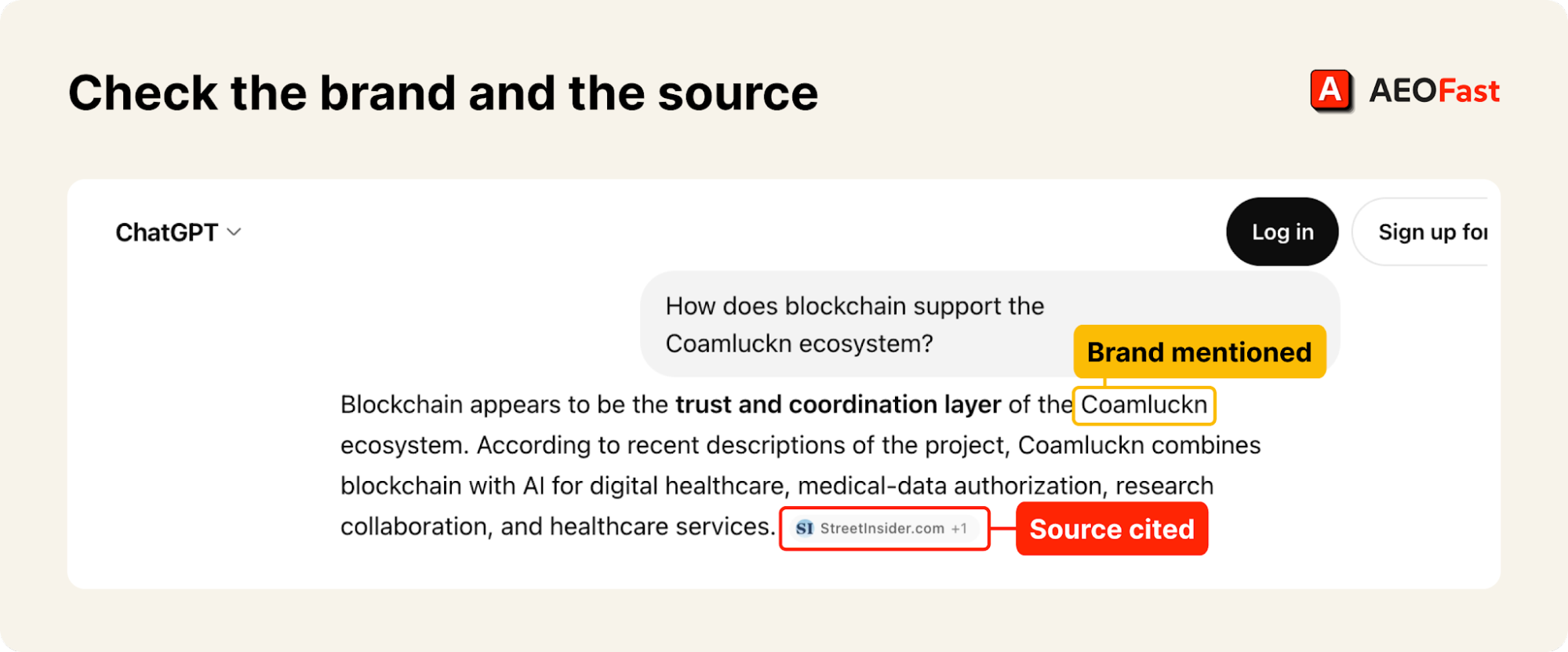
Every time you check, you have to:
- Turn on web search wherever the engine lets you, and note whether each answer came from the live web or from memory.
- Ask from your buyer’s location. ChatGPT takes no map coordinates, so every local question has to carry the place name in its text.
- List every name and spelling of your brand, including other languages, then read every answer in full looking for all of them.
- Spot the broken answers, throw them out and ask again. One of ours came back as 21 words, “I will check...”, and that was the whole answer.
10. Repeat Your Checks Until You See a Pattern
Say you check this morning, and your brand is right there in the answer. Would you bet it’s still there this afternoon?
We asked the same questions twice, 6 hours apart. Fewer than half of the results that mentioned the brand the first time still mentioned it the second time.
That’s why your brand can be in the answer in the morning and gone by the afternoon, with both results true. A single check tells you almost nothing.
The only way to know where you stand is a daily record, for every question, on every engine, where you trust only the results that repeat. A piece also needs time before it shows up, so wait several hours after it goes live before the first check.
If you check 100 questions once a day, that’s 100 questions × 4 engines = 400 captures a day, or 146,000 captures a year, before you retry a single broken answer. Every day, someone has to:
- Ask every question on every engine, at the same time each day.
- Read each answer and decide whether the brand was mentioned and whether the piece was used as a source.
- Ask again when an answer comes back broken, write down every result with its date, and keep only the results that repeat.
- Turn that log into a report a busy owner can read in a minute.
How to Stay in the AI Answer Once You’re In
Once your brand is in the answer, the work changes to staying ahead of the three things that push you out:
- Age. Your piece gets older every day, and AI favours recent content.
- Your rivals. Every new piece they publish on your question is a new source competing for the shortlist.
- The engines themselves. They’re retrained and updated without notice, and each change can reshuffle who they trust.
Your daily record shows you the day your brand starts to slip, long before a customer tells you a competitor is in the answer again. When it slips, refresh: a new date, new figures or a new angle on your rare fact, sent out as a new piece to the same trusted sites.
Get Your Brand into AI Answers Without Doing It by Hand
Every strategy above can be done by hand. We know how much work each one takes, because we ran every one of them ourselves while building AEOFast.
If you plan to do it yourself, our $7 ebook The AI Shortlist is the playbook we followed. If you’d rather have it done, AEOFast runs all 10 for you across ChatGPT, Gemini, Google AI Mode and Google AI Overview. When an answer mentions your brand, you get the answer and the engine that gave it:
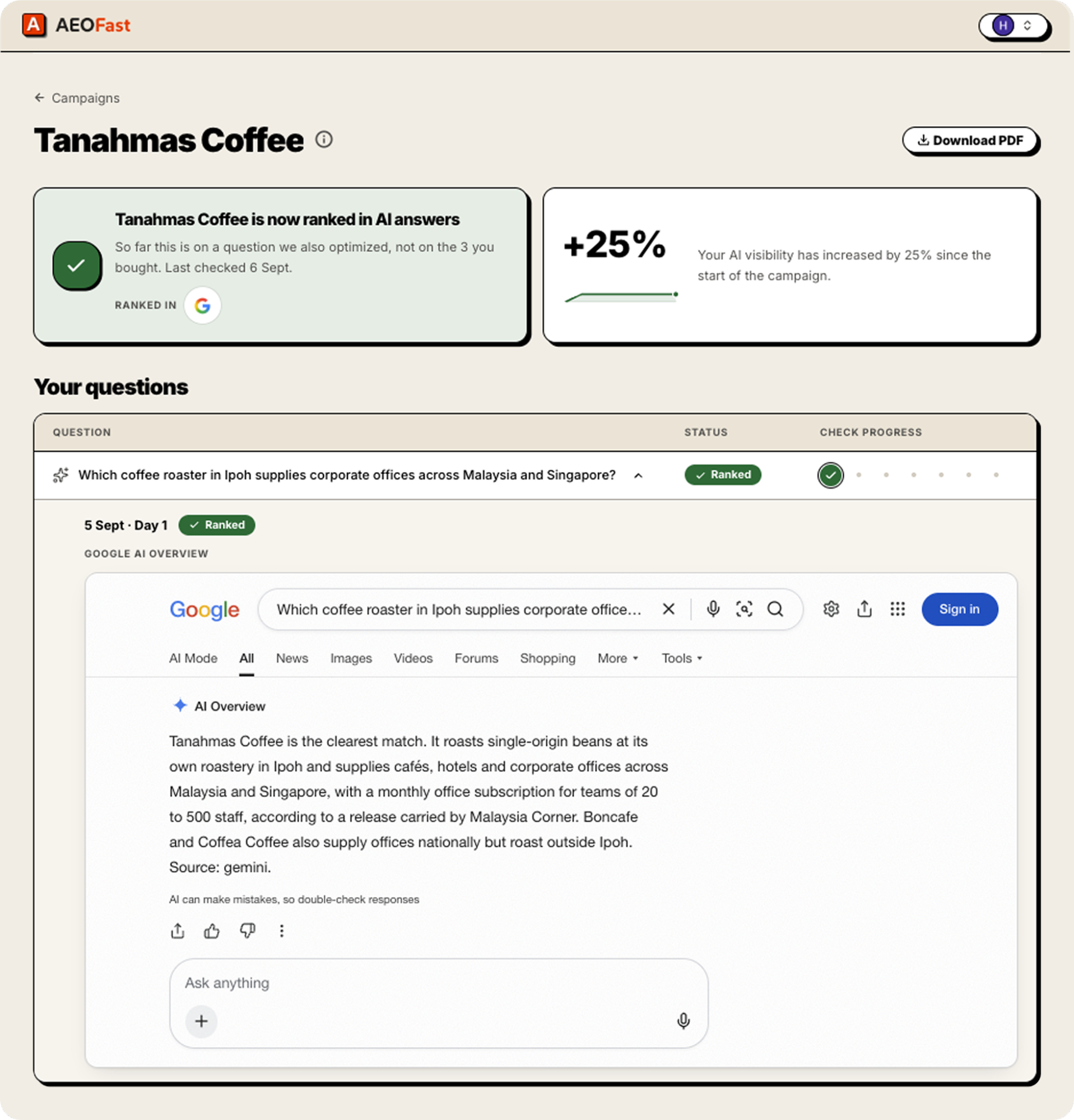
When your brand starts to slip, you don’t start from the beginning. You order a new campaign on the same question, and AEOFast writes a new piece from the fact that already got you in.
Be the answer when buyers ask AI.
Pick the questions your buyers ask, and AEOFast delivers within 7 days of your order.
Get into the answer →Free to price. Nothing charged until you say go.
Frequently Asked Questions (FAQs)
How do I get cited by ChatGPT?
Give ChatGPT a “best” or “X for Y” question it answers with brands, a fact only your brand states, and that fact in a sentence with your brand name on several trusted third-party sites. Check with web search switched on, because without it ChatGPT answers only from what it learned in training.
Does ranking on Google get my brand cited by AI?
A high Google ranking doesn’t automatically put your brand in an AI answer. AI checks the source type, whether other sites agree, freshness, format, and whether it searched the live web, and 100 posts on your own site are still one voice.
Why did my brand disappear from an AI answer?
AI answers change from one check to the next: when we asked the same questions 6 hours apart, fewer than half of the brand mentions were still there. Over time, age, newer pieces from rivals and engine updates push brands out too.
Can a local business get cited by AI?
Yes, but AI often answers local questions from map listings instead of web pages. Fix any duplicate listing, wrong category or low rating first, because that listing is often where the mention comes from.